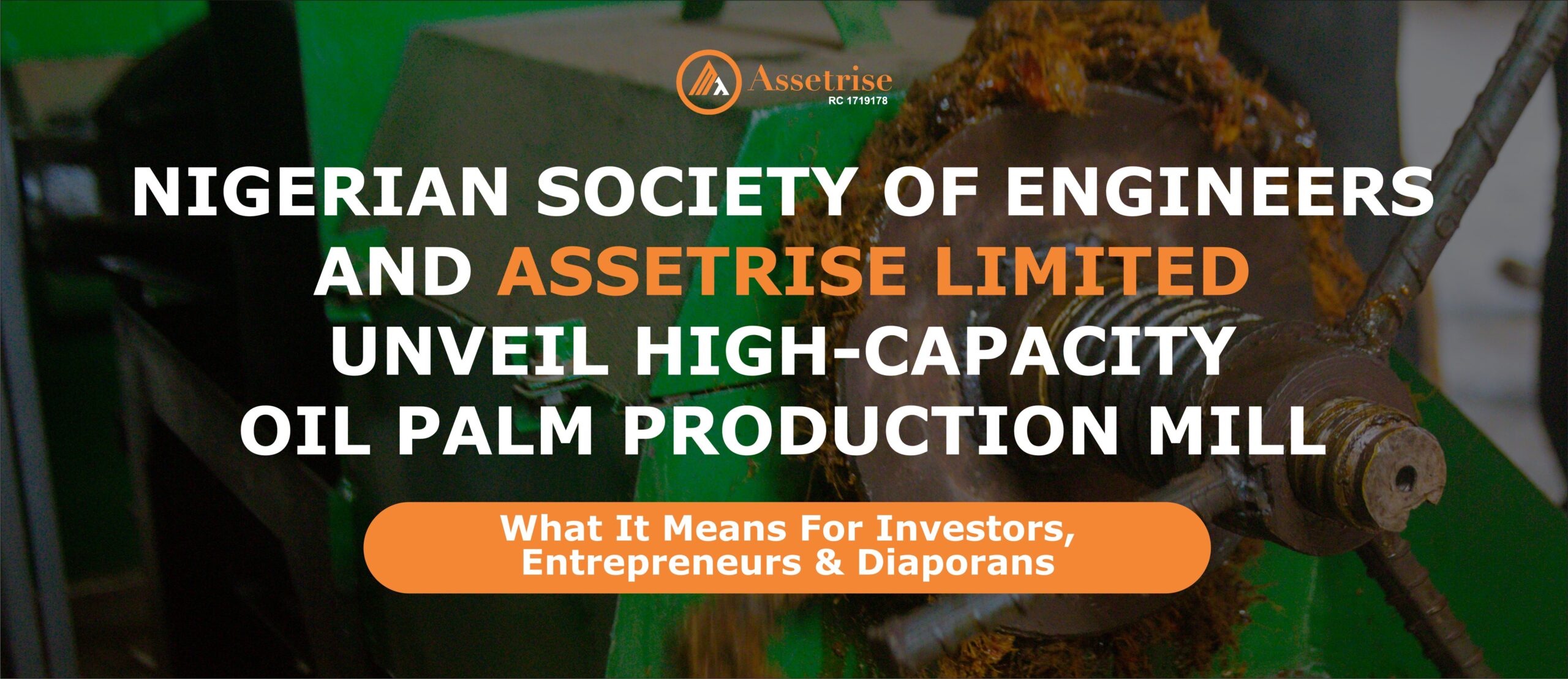
Assetrise Limited, widely recognized as the pioneer of Agro-Real Estate in Africa, in partnership with the Nigerian Society of Engineers (NSE), has officially commissioned a 3-tonnes-per-hour, fully locally fabricated palm-oil processing mill at Palmrich Estate Phase 5, Ibadan. The installation, integrated into a larger ranching and agro-industrial system is being billed as a practical demonstration of how engineering, local fabrication and integrated value chains can close Nigeria’s palm-oil supply gap and create new investor opportunities.
This milestone marks a new era of engineering-led agricultural development, strengthened by Assetrise’s commitment to transforming land ownership into productive, export-ready, sustainable, wealth.
NSE: Engineering Nigeria’s Agro-Industrial Future
The Nigerian Society of Engineers, Nigeria’s foremost professional engineering body, played a central role in the design, fabrication, and installation of the mill, proving that world-class agro-industrial machinery can be built locally, efficiently, and competitively.
With over six decades of advancing engineering excellence, the NSE continues to champion:
- Indigenous engineering solutions
- Local industrial capacity development
- Technology-driven economic diversification
- Reduced dependence on imports
Through this collaboration, the NSE has demonstrated that Nigeria possesses the technical depth to industrialize agriculture from within, adapting machinery to local terrain, climate, and production realities at a fraction of import costs.
Speaking at the launch, Dr. Felicia Nnenna Agubata, Vice President (Corporate Services), Nigerian Society of Engineers, described the project as a national benchmark:
“This partnership with Assetrise proves that Nigeria can design and build what it needs to feed itself, industrialize agriculture, and strengthen its economy. These mills were fabricated by Nigerian engineers, and that sets a new standard for engineering-led development.”
She further highlighted the importance of integration:
“By combining plantation development, processing, and ranching into one system, Assetrise is demonstrating the future Nigeria needs: secure, mechanized, technology-driven, and sustainable.”
According to Mr. Rotimi Ojamamoye, Group Managing Director, Assetrise Limited, the project reflects a much broader vision:
“Palmrich Phase 5 shows that Agro Real Estate is the future of wealth creation in Nigeria. This infrastructure delivers value, supports food security, and prepares the country for a self-sustaining, export-driven agricultural system.”
He also emphasized the estate’s response to national policy shifts:
“With the Federal Government ending open grazing, new agricultural systems must emerge. Ranching is no longer optional; it is a national imperative. Palmrich Phase 5 demonstrates how the private sector can respond responsibly, sustainably, and profitably.”
Palmrich Phase 5: Production, Processing, and Practical Proof
Palmrich Estate Phase 5 stands as one of Nigeria’s most advanced Agro Real Estate systems, where land ownership is directly tied to measurable agricultural output.
Within the estate:
- Oil palm trees are already fruiting, with landowners receiving scheduled returns, clear evidence that agro real estate can be secure and profitable.
- New nurseries are expanding planting capacity for upcoming seasons, ensuring scalability and long-term value.
- Processing, storage, livestock, and distribution facilities operate within a single estate, creating multiple income streams across the palm oil value chain.
This is productive ownership. Backed by partners such as the Nigerian Institute for Oil Palm Research, NIFOR, Okitipupa Oil Palm Plc, and other industry stakeholders, Palmrich demonstrates how real estate can evolve into an earning, appreciating, agro-industrial asset. This combination of plantation, mill, and ranch converts speculative landholding into a measurable, cash-flowing investment.
With the ongoing expansion of Palmrich Phase 5, from fruiting plantations to new nurseries and now an in-estate palm mill, the estate is set to become one of the most productive palm oil clusters in Southwest Nigeria, positioning its investors to benefit from the full palm oil value chain.
Why the Mill Matters: The Numbers
The mill gains significance against Nigeria’s structural palm-oil gap:
- National production: 1.4-1.5 million metric tonnes per year.
- National demand: 2.4 million metric tonnes per year.
- Annual shortfall: 1 million metric tonnes, representing over $600 million in annual import spending.
The newly commissioned mill changes that equation.
At Palmrich Phase 5:
- Fresh fruit bunches move directly into processing
- Crude Palm Oil (CPO) and Palm Kernel Oil (PKO) are produced on-site
- By-products such as palm kernel cake (PKC) feed livestock operations
- Waste materials are converted into organic fertilizer
Nothing is wasted. With the commissioning of this mill, fresh fruit bunches harvested within the estate move directly into primary processing, producing Crude Palm Oil (CPO) and Palm Kernel Oil (PKO), two commodities whose domestic prices have climbed by more than 40% in the last two years due to rising demand from the Fast-Moving Consumer Goods (FMCG), cosmetics, and energy sectors. Every part of the palm fruit is further converted into commercially valuable secondary products like palm kernel cake (PKC) for livestock feed, a sector projected to reach a market value of ₦1.2 trillion by 2027 as Nigeria expands its poultry and cattle production. Empty fruit bunches are processed into organic fertilizer, feeding back into the estate’s soil regeneration system. This zero-waste model is central to the estate’s sustainability philosophy and sharply contrasts with the outdated, extractive practices that dominate much of the Nigerian palm oil sector. By bringing local processing capacity closer to production, estates like Palmrich reduce transport friction, improve margins for local producers, and retain value that would otherwise leave the economy.
Nationwide End to Open Grazing: Assetrise Leads the Private-Sector Response
With the Federal Government’s move to end open grazing as part of Nigeria’s national security and agricultural modernization agenda, the country is transitioning to structured, controlled livestock systems. This shift requires scalable private-sector solutions that align security, sustainability, and profitability.
Assetrise is responding with a fully integrated, investment-ready ranching model embedded within Palmrich Estates. The system eliminates the risks of open grazing by operating within secure, regulated environments and linking livestock development directly to crop production and processing.
Livestock is fed using high-protein palm kernel cake (PKC) generated from the estate’s new 3-tonnes-per-hour palm oil mill, creating a closed-loop, zero-waste system that improves efficiency and reduces input costs.
By 2030, Assetrise targets the development of over one million cattle supported by modern abattoirs, dairy processing, and infrastructure, reducing reliance on meat and dairy imports while strengthening national food security.
The Palmrich ranching model represents the future of livestock development in Nigeria: secure, scalable, technology-enabled, and commercially viable.
What This Means for Investors, Entrepreneurs & the Diasporans
For Individual Investors and Professionals
Palmrich fundamentally redefines agricultural land ownership. Instead of speculative land banking, investors own productive, income-generating agro-real assets where value is realised across multiple layers, cultivation, processing, by-product conversion, and distribution.
Investors benefit from:
- Returns from fruiting oil palm trees, not future promises
- Participation in processing margins through the estate’s in-house mill
- Long-term land appreciation.
- A hedge against inflation through real assets tied to essential commodities
For salaried professionals, mid-career earners, and families planning long-term security, Palmrich offers a patient, asset-backed pathway to wealth preservation and growth, particularly in an economy prone to currency volatility.
For Pre-Retirement and Retirement Planning
For individuals approaching retirement, senior professionals, civil servants, executives, and diaspora returnees, Palmrich provides an alternative to traditional pension-heavy strategies.
The model offers:
- Passive income streams linked to agricultural production
- Assets that continue to produce well beyond active working years
- Reduced exposure to stock market volatility
- A tangible legacy asset that can be transferred intergenerationally
Unlike high-risk speculative instruments, agro real estate offers stable income from agriculture and real estate.
For Entrepreneurs, SMEs, and Agribusiness Operators
Palmrich Phase 5 creates an agro-industrial system, not just farmland. The on-site mill creates business opportunities across the value chain, including:
- Logistics and haulage services
- Packaging, storage, and warehousing
- Palm oil refining and fractionation
- Livestock feed production using palm kernel cake (PKC)
- Export aggregation and commodity trading
For agripreneurs and MSMEs, this drastically lowers entry barriers by providing infrastructure, raw material proximity, and scalable demand within a single estate.
For Corporate and Institutional Investors
Palmrich offers corporate bodies a credible pathway to diversify asset holdings into productive land-backed industries. It presents a structure suitable for:
- Institutional asset allocation
- Corporate treasury diversification
- ESG-aligned investments
- Supply-chain backward integration
The integrated mill, ranching system, and zero-waste model strengthen the estate’s attractiveness to pension funds, insurance firms, cooperatives, and asset managers seeking long-term, inflation-resistant investments tied to national impact.
For The Diasporans
For diaspora investors, Palmrich addresses a long-standing challenge: how to invest back home safely, transparently, and productively.
The estate provides:
- Verifiable land titles and allocations
- Professionally managed agricultural operations
- Documented production and processing outputs
- Clear governance and partner institutions
Rather than idle plots or opaque ventures, diaspora capital flows into working assets that generate income while strengthening Nigeria’s domestic food and industrial capacity.
For Cooperatives, Associations, and Professional Bodies
Palmrich is also suited for:
- Professional associations
- Cooperative societies
- Faith-based investment groups
- Alumni bodies and unions
Group participation through the Special Purpose Vehicle (SPV), enables members to pool resources into large-scale agro assets with shared returns, professional management, and clear exit frameworks.
For Governments, Development Institutions, and NGOs
From a policy and development perspective, Palmrich represents a scalable template for national replication. It directly supports:
- Food security and import substitution
- Rural job creation and skills development
- Industrial decentralisation
- Youth and women’s inclusion
- Climate-smart and zero-waste agricultural systems
Institutions such as state governments, development banks, and multilateral partners can leverage this model to deliver measurable impact while crowding in private capital.
For Nigeria’s Long-Term Economic Future
By integrating land ownership, production, processing, livestock, and logistics, Palmrich transforms agriculture into a structured, bankable, and industrial asset class.
It shifts agriculture:
- From subsistence to scalable enterprise
- From raw production to value capture
- From imports to exports
The NSE-Assetrise mill is a practical, engineering-led proof that Nigeria can reconfigure its agricultural economy from fragmented production to integrated agro-industrial clusters. For investors, entrepreneurs and the diaspora, the message is clear: well-structured agro-real estate that couples production with processing and governance can deliver long-term income, national impact, and export potential.
Assetrise invites interested individuals, institutions, and diaspora communities to explore ownership opportunities within Palmrich Estate and to partner in scaling the model across Africa.
Own the land that produces. Own an asset that earns.
Contact us today to get started.
Limited units available.